What You Need To Know
- Desi cuisine is the home-style cooking of the Indian subcontinent, mainly Pakistan, India, and Bangladesh, plus the diaspora that carries it abroad.
- “Desi” comes from the Sanskrit word for “land” or “country,” so desi food simply means food from home.
- The flavor signature is layered spice, slow-cooked onion and tomato bases, smoke from clay ovens, and bread or rice to scoop it all up.
- The most popular desi dishes include biryani, karahi, handi, nihari, seekh kebab, tikka, dal, naan, and gulab jamun.
- Desi food is not always fiery. Most heat is optional; aroma comes from cumin, cardamom, cloves, and garam masala.
Desi cuisine is the everyday and celebration cooking of the Indian subcontinent, and if you’ve ever torn naan to scoop up a karahi, you’ve already eaten it.
So what is desi food beyond that one plate? It’s a family of regional kitchens that share spices, techniques, and a deep habit of feeding guests far more than they asked for.
We’ve cooked Pakistani clay-pot food in Buffalo since 2011, and here’s our honest take: the best way to understand desi food is not a recipe. It’s one slow-cooked dish, eaten by hand, at a slightly crowded table. This guide gives you the vocabulary first.
What is desi food, exactly?
Desi food is the traditional, native cooking of South Asia, especially Pakistan, India, and Bangladesh, and of South Asian families living abroad. According to Wikipedia’s entry on Desi, the word traces back to the Sanskrit “desha,” meaning land or country, and was first recorded in the Natya Shastra around 200 BCE.
Think of “desi” the way Americans say “homemade” or “country cooking.” It doesn’t name one dish. It names where the food comes from and how it feels.
In South Asia the literal sense survives: “desi ghee” is clarified butter made the traditional way.
Is desi cuisine the same as South Asian food?
Mostly yes: desi cuisine is the everyday name South Asians use for South Asian food. “South Asian food” is the formal term you’ll see in cookbooks and menus. “Desi” is what people say at home.
The term usually covers Pakistani, Indian, and Bangladeshi cooking. Some definitions stretch it to Nepal, Sri Lanka, Bhutan, and the Maldives.
Here’s the honest caveat: not everyone loves the label. NBC News reported in 2021 that some in the diaspora feel “desi” flattens very different cultures into one.
We use it because our guests do, but a Bengali fish curry and a Peshawari chapli kebab are worlds apart.
What do desi flavors actually taste like?
Desi flavors stack five things at once: warmth, heat, tang, smoke, and richness. A good karahi hits all five in one bite. That layering is what separates it from food that’s simply “spicy.”
- Warmth: cinnamon, cloves, cardamom, and cumin give depth without burning.
- Heat: green and red chilies, adjustable at almost every restaurant.
- Tang: tomato, yogurt, lemon, and tamarind cut through fat.
- Smoke: the tandoor (clay oven) and open-fire cooking add char.
- Richness: ghee, slow-reduced onions, and long braises.
Picture a song with bass, drums, melody, and harmony playing together. Remove one and it still works, but it sounds thin. Desi cooks build dishes the same way, in layers.
Which spices in desi cooking matter most?
The essential spices in desi cooking are cumin, coriander, turmeric, red chili, cardamom, cloves, cinnamon, and the blend called garam masala. Ginger and garlic, usually ground into a paste, sit underneath nearly everything.
| Spice | Urdu / Hindi name | What it adds | Where you’ll taste it |
|---|---|---|---|
| Cumin | Zeera | Earthy, toasty warmth | Dal, rice, tadka |
| Coriander seed | Dhaniya | Light citrus notes | Curries, kebab mince |
| Turmeric | Haldi | Golden color, gentle bitterness | Dal, everyday curries |
| Red chili | Lal mirch | Heat and color | Karahi, tikka marinades |
| Green cardamom | Elaichi | Floral sweetness | Biryani, chai, kheer |
| Cloves | Laung | Sharp, numbing warmth | Biryani, pulao, garam masala |
| Cinnamon | Dalchini | Sweet woody depth | Nihari, pulao |
| Garam masala | Garam masala | Rounded aroma | Finishing curries and kebabs |
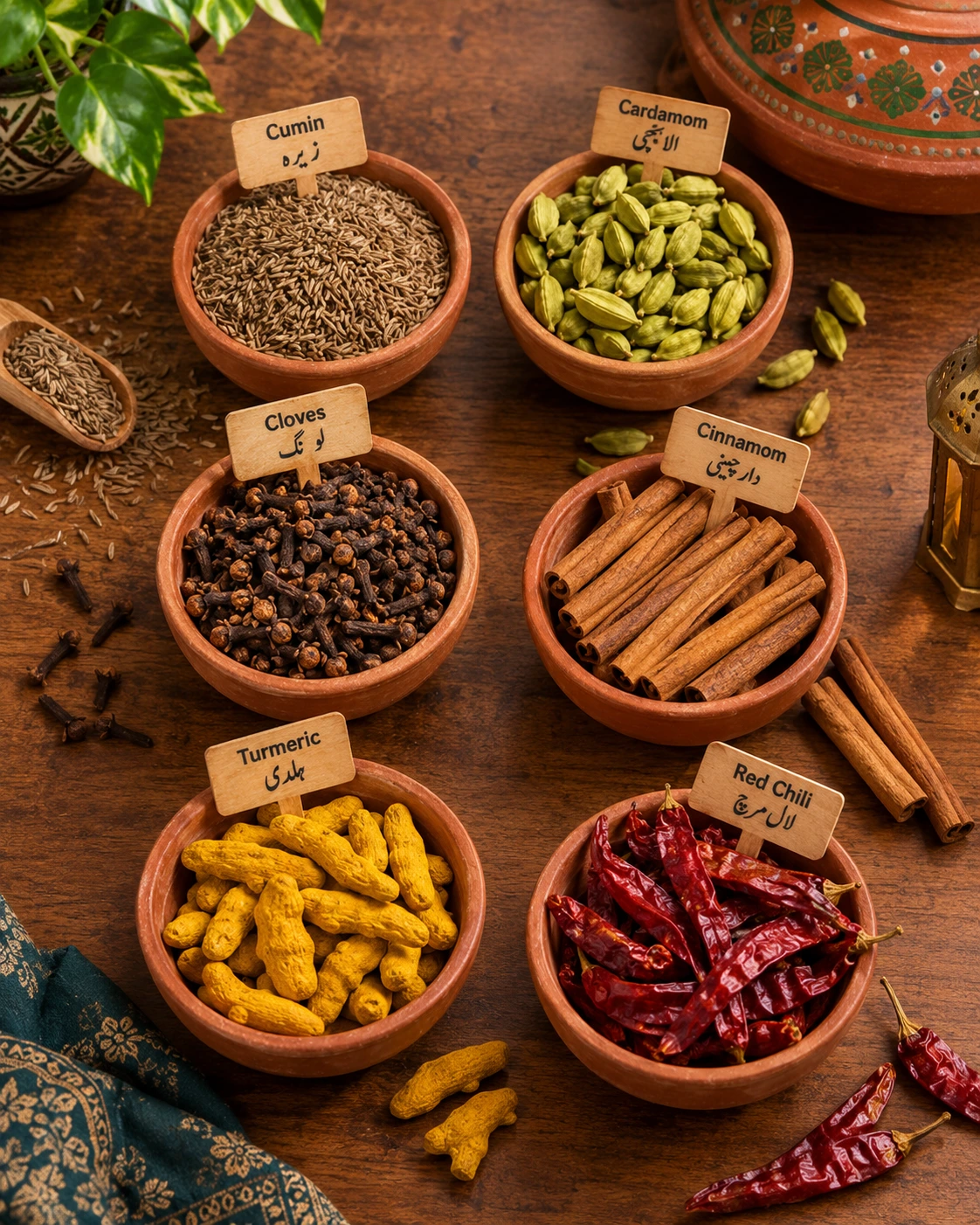
Garam masala is a blend, not a single spice. Britannica describes it as a mix built around cinnamon, cardamom, cumin, and peppercorn, balanced for aroma rather than fire.
Surprisingly, chilies aren’t native to the region.
Portuguese traders brought chilies, potatoes, and tomatoes in the 1500s, according to the WebstaurantStore guide to Indian cuisine (updated April 2026).
How do desi cooks build flavor in a pot?
Desi cooks build flavor in stages, and the order matters more than the spice list. Here’s how a classic handi or karahi comes together in our kitchen:
- Heat oil or ghee and bloom whole spices until they crackle. This is called tadka (tempering).
- Cook onions slowly until deep golden. This step, called bhuna, can take 15 to 20 minutes.
- Add ginger garlic paste, then tomatoes, and reduce until the oil separates.
- Add meat and ground spices, then cook over steady fire until tender.
- Finish with garam masala, fresh ginger, green chili, and coriander leaves.
Biryani, which spread through Mughal influence, uses a different trick called dum: the pot is sealed so rice and meat finish in their own steam.
Which popular desi dishes should you try first?
The most popular desi dishes for first-timers are biryani, chicken karahi, chicken handi, seekh kebab, tikka, naan, and gulab jamun. Global food guide TasteAtlas named butter garlic naan, tikka, and tandoori chicken among its 100 best dishes in the world, as Aaj News reported in January 2024.
- Biryani: spiced rice layered with meat, cooked dum style. The star of weddings.
- Karahi: meat cooked fast in a wok-like iron pan with tomato, ginger, and chilies.
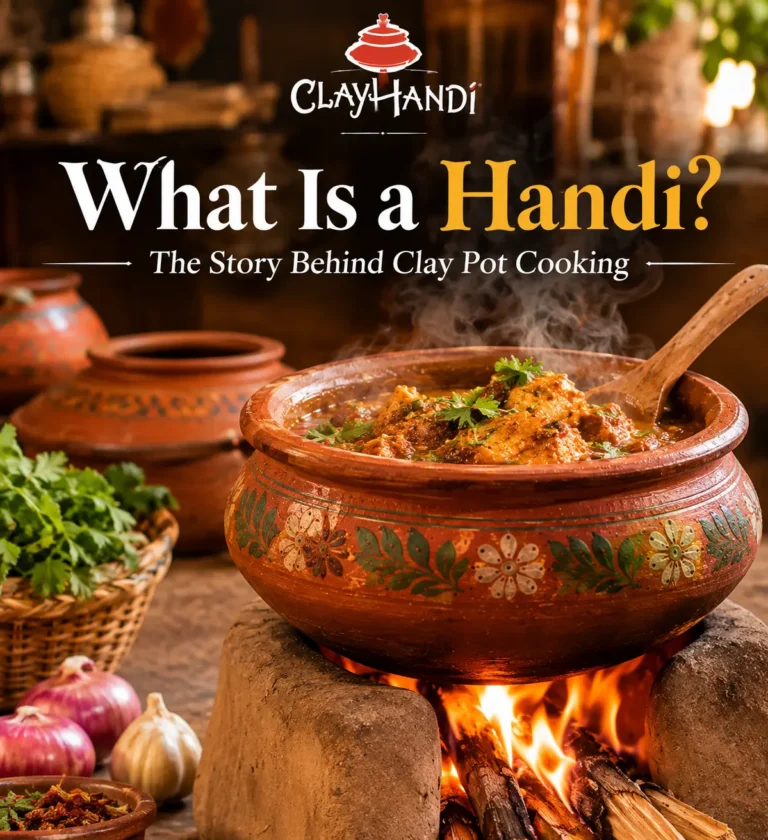
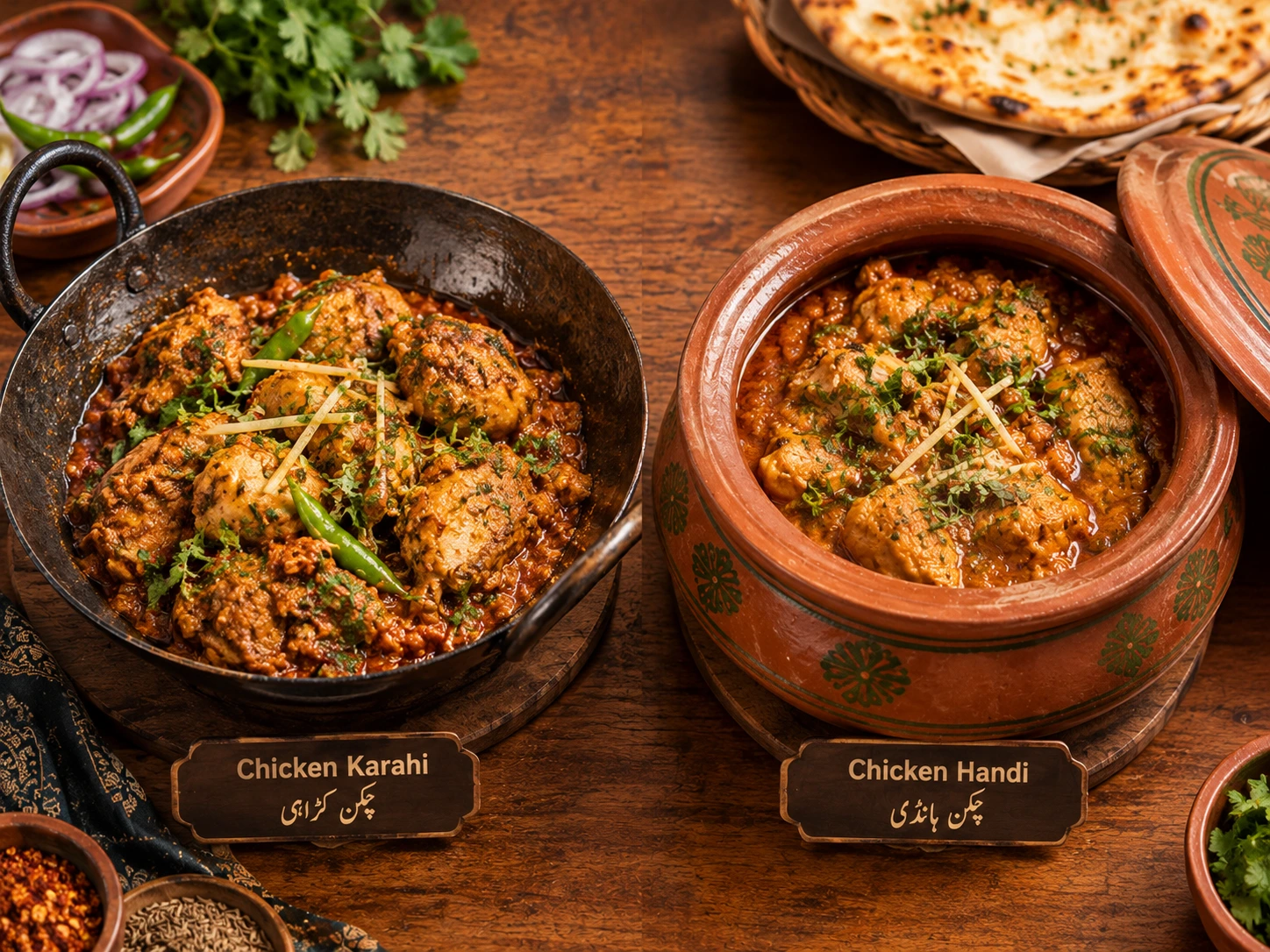
- Handi: a slower, creamier curry named after the clay pot it cooks and is served in.
- Nihari: beef or lamb stew simmered for hours, traditionally eaten in the morning.
- Haleem: meat slow-cooked with wheat, barley, and lentils until thick and silky.
- Seekh kebab: spiced mince shaped on skewers and grilled.
- Sajji: whole chicken or lamb roasted over coals, originally a Balochi dish.
- Dal: lentils, the comfort base of millions of home meals.
- Gulab jamun: soft milk dumplings in rose and cardamom syrup.
Rankings like TasteAtlas are fun, but they lean toward restaurant dishes. Home favorites like dal and paratha rarely make those lists.
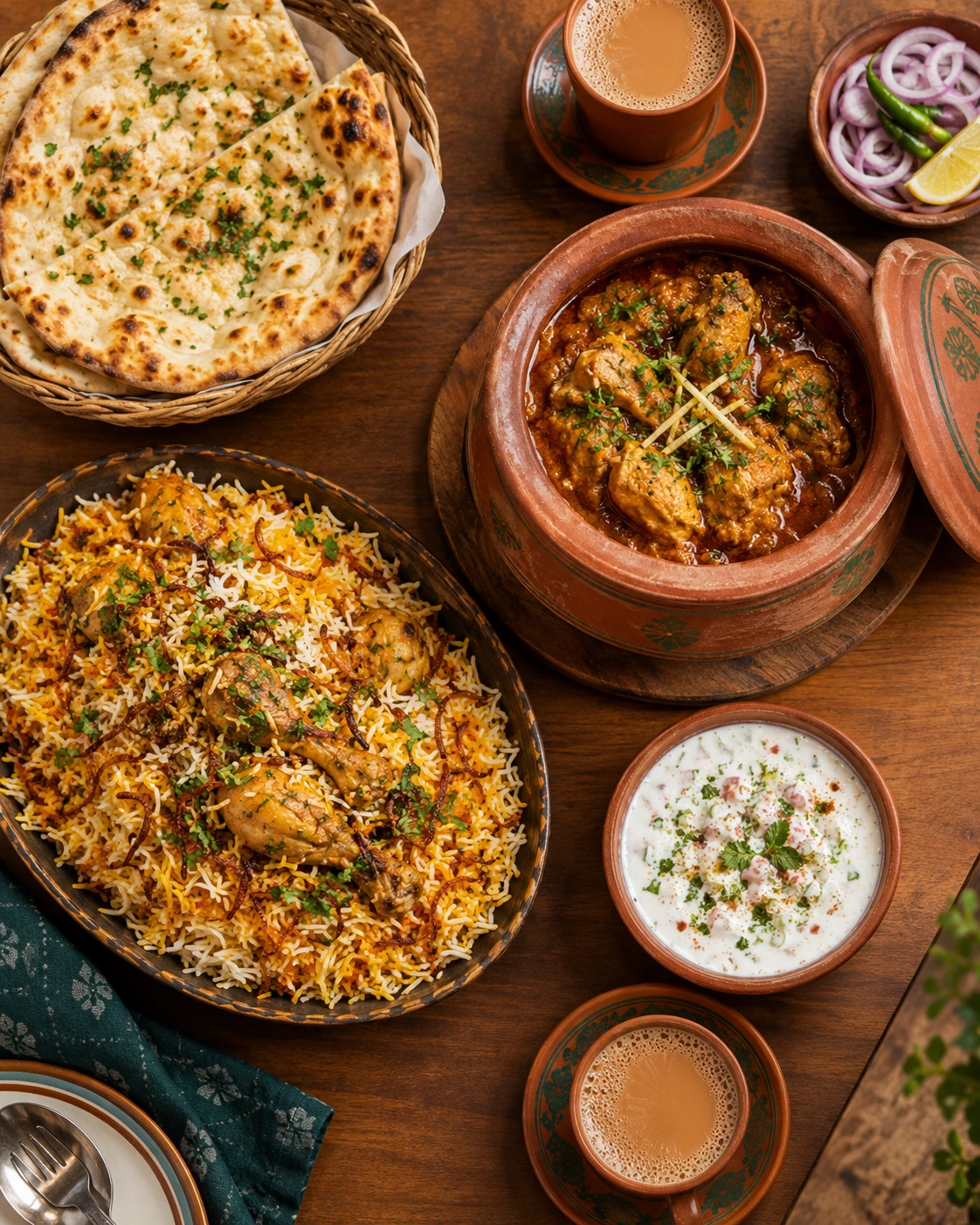
If you only order one thing on your first visit, we’d pick a chicken handi or karahi with fresh naan. It shows you the whole flavor system in one pot.
How are Pakistani and Indian dishes different?
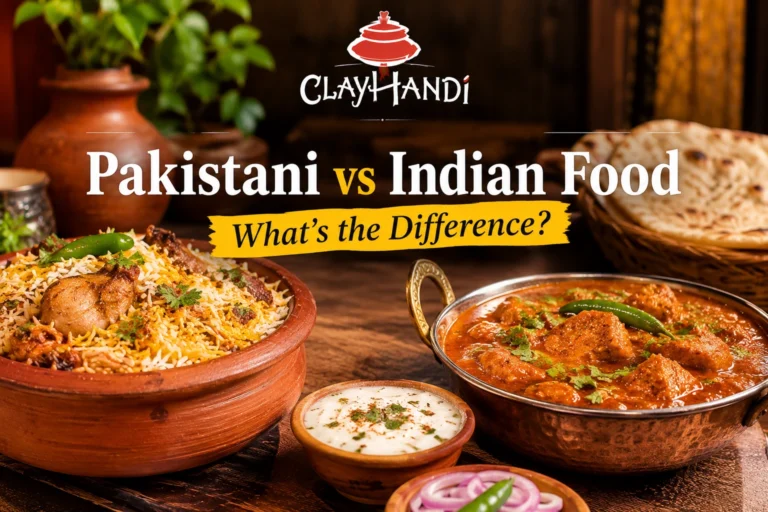
Pakistani and Indian dishes share most of their roots, but Pakistani cooking leans harder on meat, wheat breads, and grilling, while Indian cooking has a far larger vegetarian tradition. Much of the overlap comes from the Mughal Empire, whose kitchens brought kebabs, rich gravies, and the Persian roots of biryani to the north.
| Pakistani cooking | Indian cooking | |
|---|---|---|
| Center of the plate | Beef, mutton, goat, chicken | Huge range, with strong vegetarian traditions |
| Everyday starch | Wheat: roti, naan, paratha | Wheat in the north, rice in the south and east |
| Signature methods | Karahi, handi, tandoor, coal roasting | Tandoor, tadka, steaming and fermentation in the south |
| Dishes to know | Nihari, haleem, sajji, chapli kebab | Butter chicken, masala dosa, chole, sambar |
| Shared favorites | Biryani, samosa, dal, naan, tikka, gulab jamun | Biryani, samosa, dal, naan, tikka, gulab jamun |
Honestly, borders matter less than regions. Punjabi food from Lahore and from Amritsar have more in common than Lahore food has with Karachi’s.
If you want to explore both sides, see our signature Pakistani cuisine and our traditional Indian dishes.
What do common desi food names mean?
Most desi food names describe the cooking vessel, the cut of meat, or the time of day. Once you know a dozen words, almost any menu reads clearly.
| Desi food name | What it means | Example |
|---|---|---|
| Handi | Clay or metal cooking pot | Chicken handi |
| Karahi | Wok-shaped iron pan | Goat karahi |
| Tandoori | Cooked in a clay oven | Tandoori chicken |
| Tikka | Boneless chunks, grilled | Chicken tikka |
| Seekh | Skewer | Seekh kebab |
| Nihari | From “nihar,” morning | Beef nihari |
| Paratha | Layered, pan-fried flatbread | Aloo paratha |
| Puri | Puffed, deep-fried bread | Halwa puri |
| Masala | Spice mix or spiced sauce | Chana masala |
| Raita | Yogurt with cumin and herbs | Cucumber raita |
| Chai | Milk tea brewed with spices | Doodh patti chai |
The nihari meaning comes from Urdu. UrduPod101 explains that “nihar” means morning, and beef nihari usually takes six to eight hours to cook.
What counts as traditional desi food?
Traditional desi food is the cooking tied to family routines: breakfast, Friday lunches, weddings, and religious holidays. These dishes take time, and that time is the point.
- Breakfast: halwa puri with chana, aloo paratha, nihari, and paye.
- Weddings: biryani cooked in huge pots, kebabs, and qorma.
- Holidays: sheer khurma for Eid, haleem for big family gatherings.
Our weekend desi breakfast menu is built around this tradition, and it’s the meal our guests from Pakistan get most nostalgic about.
Why does desi comfort food feel like home?
Desi comfort food is simple, slow, and shared: dal chawal, khichdi, aloo paratha with chai, and a pot of curry everyone tears naan into. It’s less about the recipe and more about who made it.
Clay-pot cooking is our favorite example. A handi is a porous clay vessel that breathes, absorbs spice, and softens heat, a little like a cast-iron skillet that seasons over years. Food cooked in it tastes rounder. That’s why we serve each handi in the pot it was cooked in.
One first-timer put it better than we could. In a Google review, she wrote that the lamb in her clay pot was so tender “you had to scoop it.” That’s desi comfort food doing its job.
Want to taste the difference a clay pot makes? Book a table at Clay Handi on Delaware Ave in Buffalo, open every day from 9:00 AM to 2:00 AM.
How should a first-timer order desi food?
Order desi food by choosing one curry, one grilled item, one bread or rice, and one sweet, then share everything. That’s how families eat, and it’s the easiest way to learn what you like.
- Pick one pot dish, like a handi or karahi, and ask for medium spice.
- Add something from the grill, such as seekh kebab or tikka.
- Choose naan for curries or biryani for a rice-centered meal.
- Cool things down with raita or a mango lassi.
- Finish with gulab jamun, kheer, or gajar halwa.
One caveat: not every desi restaurant is halal, and some serve alcohol. If that matters to you, ask directly. At Clay Handi, everything we serve is 100% halal.
Vegetarian or vegan? Desi kitchens are some of the easiest anywhere for plant-based eaters. Start with dal, chana masala, or aloo gobi from our vegan and vegetarian dishes.
Frequently asked questions about desi food
Is all desi food spicy?
No. Most desi spices, like cumin, cardamom, and cinnamon, add aroma rather than heat. Chili is the adjustable part, and most restaurants cook mild, medium, or hot on request. Handi, haleem, and dal are flavorful without being fiery, so ask for mild and add green chutney at the table.
Is desi food halal?
Not automatically. Halal means food permissible under Islamic law, with meat slaughtered a specific way. Pakistani and Bangladeshi kitchens are usually halal, while Indian restaurants vary. The reliable check is asking who certifies the meat and whether alcohol is served.
What is the most popular desi food?
Biryani is widely considered the most popular desi food, followed closely by naan, chicken tikka, and karahi. Biryani appears at weddings, Eid dinners, and casual family meals across Pakistan, India, and Bangladesh. In the United States, butter chicken and tikka masala are often the first dishes new diners try, but biryani is the one South Asian families argue about most.
Is desi food the same as Indian food?
Desi food includes Indian food, but it’s broader. Desi covers Pakistani, Indian, and Bangladeshi cooking, and sometimes Nepali and Sri Lankan food too. Indian food is one national cuisine inside that family. A Pakistani restaurant serving nihari, sajji, and chapli kebab is a desi restaurant, even though those dishes rarely appear on a typical Indian menu in the US.
What is the difference between a handi and a karahi?
Both are named after their cooking pots. A karahi is a wide iron pan where meat cooks fast over high heat, giving a drier, sharper curry. A handi is a deep clay pot used for slower cooking, giving a richer, creamier gravy. Both pair best with naan or roti.
The bottom line on desi cuisine
Cheat Sheet
- What it is: the native home cooking of Pakistan, India, Bangladesh, and the South Asian diaspora.
- How it tastes: layered warmth, adjustable heat, tang, smoke, and richness.
- Key spices: cumin, coriander, turmeric, chili, cardamom, cloves, cinnamon, garam masala.
- Start with: chicken handi or karahi, seekh kebab, naan, biryani, and gulab jamun.
- Best for first-timers: share several dishes and ask for medium spice.
Desi food rewards curiosity. Order something you can’t pronounce, eat it with bread instead of a fork, and ask the kitchen what they’d eat.
If you’re near Buffalo, Kenmore, or Niagara Falls, we’d love to cook for you. Read how Clay Handi started or reserve a table for your first handi.
About Clay Handi
Clay Handi is a family-run, 100% halal Pakistani and Indian restaurant founded in 2011 by Murshad Masud Qazi. We cook handis over open fire and serve them in their clay pots.
Visit us at 3054 Delaware Ave, Buffalo, NY 14217, call (716) 877-7797, or email info@clayhandi.com.