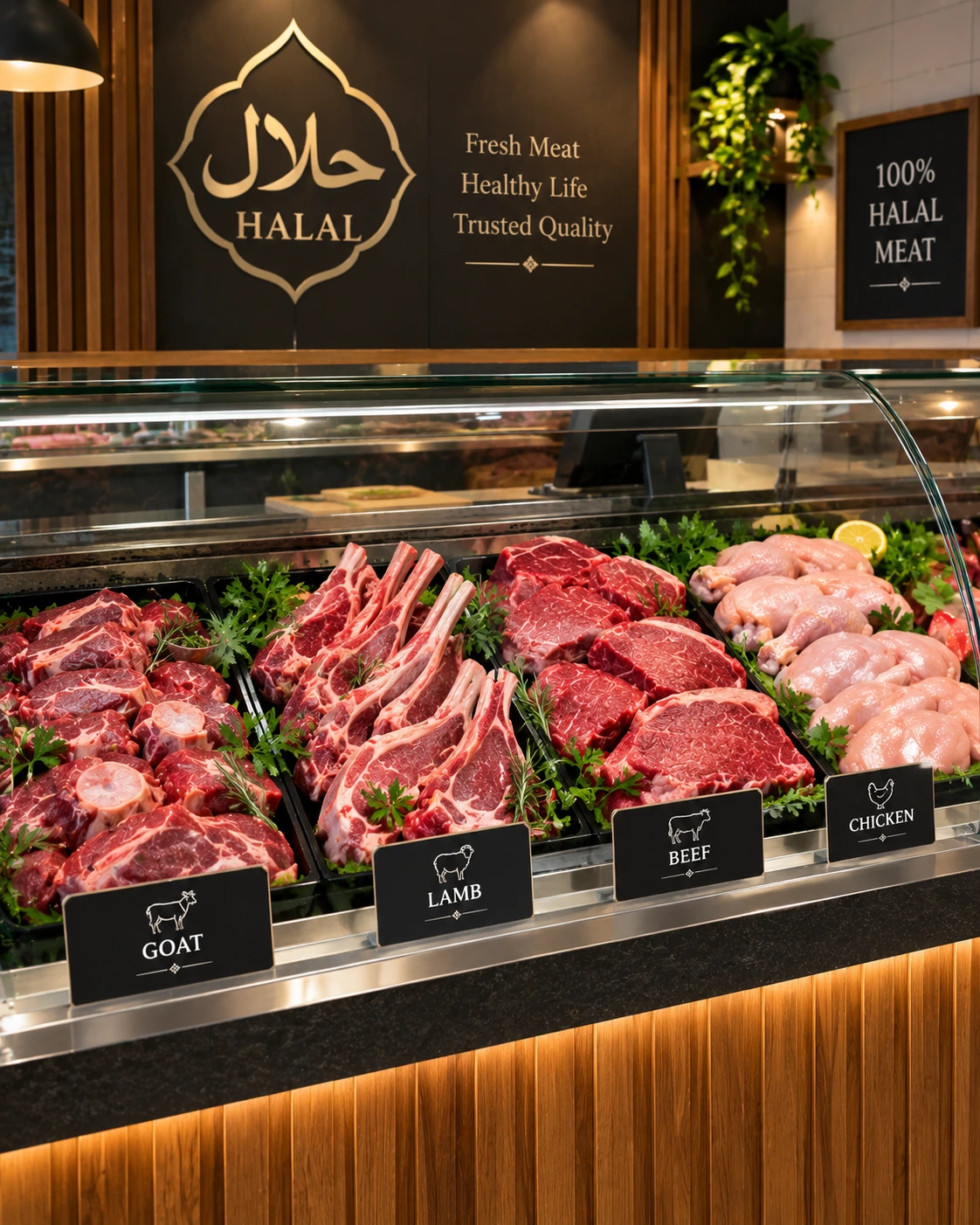
30-Second TL;DR: What You Need To Know
- Halal meat comes from a permitted animal, slaughtered by a Muslim with a single swift cut while God’s name is said, with the blood drained and no contact with pork or alcohol.
- Non-halal meat fails at least one of those tests: wrong animal, wrong slaughter method, or contamination after slaughter.
- Haram meat is the strictest category: pork, carrion, blood, and animals dedicated to anything other than God are forbidden outright.
- Zabihah (also spelled zabiha, dhabiha, or dhabihah) is the name of the slaughter method itself.
- Taste and nutrition are mostly the same. Freshness, breed, and the butcher matter more than the label.
The difference between halal vs non-halal meat comes down to three things: which animal it is, how it was slaughtered, and how it was handled afterward. The meat in both cases can come from the same breed, the same farm, even the same day. What changes is the process.
We cook only zabihah halal meat at Clay Handi, and guests ask us about it every week. Here’s our honest view: the label matters far less than whether you trust the person standing behind it.
What is the difference between halal and haram meat?
Halal means permitted under Islamic law, and haram means forbidden. For meat, halal requires a permitted animal slaughtered correctly. Haram covers meat Islam prohibits outright, no matter how it was prepared.
The Quran lists the core prohibitions in Surah Al-Ma’idah, verse 5:3: carrion, blood, pork, and animals dedicated to other than God. Animals killed by strangling, a blow, a fall, or goring are also excluded.
So there are really three buckets:
- Halal: a permitted animal (beef, lamb, goat, chicken, turkey, duck) slaughtered by the zabihah method.
- Non-halal: a permitted animal that was not slaughtered or handled correctly.
- Haram by nature: pork, carnivores, birds of prey, and blood. These can never become halal.
That middle bucket is where most confusion lives. Scholars differ on meat from Christian and Jewish slaughterhouses, which some accept based on Quran 5:5. Most halal restaurants, ours included, simply avoid the question by using zabihah meat only.
What is the halal slaughter method?
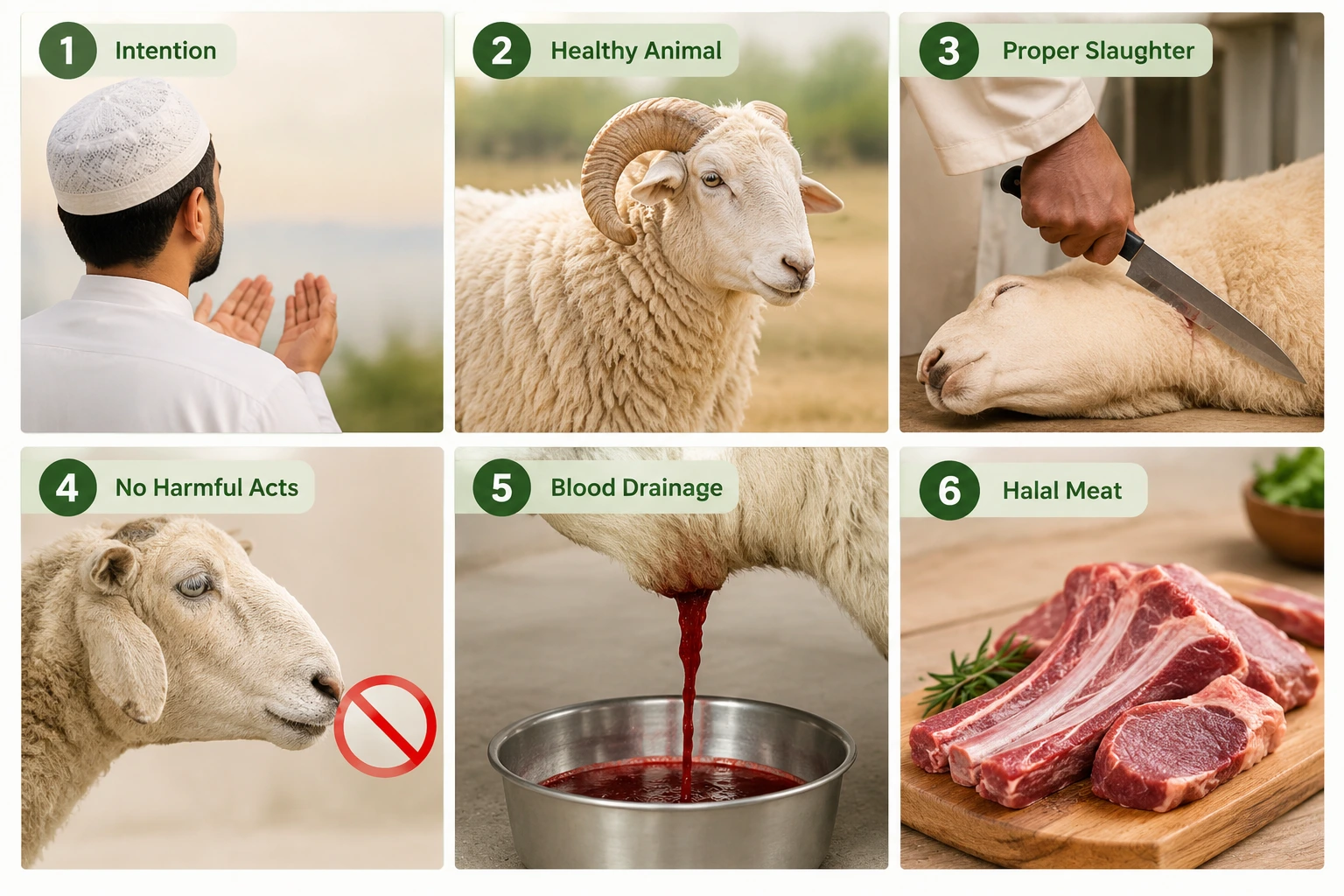
The halal slaughter method, called zabihah or dhabihah, is a single swift cut across the throat with a sharp knife while the animal is alive, after God’s name is said. The cut severs the windpipe, food tube, and major blood vessels so the blood drains out.
- A Muslim of sound mind performs the slaughter with clear intention.
- The animal is healthy, calm, and given water before slaughter.
- The slaughterer says “Bismillah, Allahu Akbar” before the cut.
- One swift cut severs the throat, carotid arteries, and jugular veins.
- The blood drains fully before any further processing.
- The meat is kept apart from pork, alcohol, and non-halal products.
Think of it like a kosher kitchen or a nut-free bakery. The ingredient might look identical, but the rules about how it’s made and stored decide whether it qualifies.
In the United States, federal law recognizes this kind of slaughter.
The Humane Methods of Slaughter Act lists ritual slaughter by a single cut to the carotid arteries as a humane method.
The Humane Methods of Slaughter Act also exempts religious slaughter from its stunning rules, so halal and kosher plants can legally slaughter without stunning.
Zabihah vs halal: are they the same thing?
All zabihah meat is halal, but not everything labeled “halal” is zabihah. Zabihah describes the slaughter method. “Halal” is a broader word that also covers drinks, snacks, and cosmetics with no meat at all.
Islamic Services of America notes that in countries where Muslims are a minority, the word halal sometimes gets used loosely. That’s why many families ask for “zabihah” by name.
You’ll also see Zabihah as a brand. Zabihah.com calls itself the original and largest halal restaurant guide, and it’s where many of our guests first find us.
Is stunning animals halal?
Some halal certifiers accept stunning and others reject it. The core condition is that the animal must still be alive at the moment of the cut. Stunning that is reversible, meaning the animal would recover if not slaughtered, is accepted by certain bodies. Stunning that kills is never halal.
Halal stunning is more common than many people assume.
The UK’s 2024 FSA Slaughter Sector Survey found 53% of all sheep in England and Wales were slaughtered by halal stun methods.
The RSPCA estimates that 88% of animals slaughtered for halal meat in the UK in 2024 were stunned, as Hyphen reported in August 2026.
Alongside the RSPCA figure, Hyphen’s report says the FSA found no clear evidence that welfare breaches were more or less likely during non-stun slaughter.
If stunning matters to you, in either direction, ask the butcher or restaurant which certifier they use. That one question tells you everything.
Does halal meat taste different?
Halal meat taste is usually the same as non-halal meat from a similar animal. Most of what people notice comes from freshness, breed, feed, aging, and cooking, not the slaughter itself.
The best recent evidence is small but useful.
A 2025 study in the journal Animals compared conventional, halal, and halal-with-reversible-stunning beef from 45 samples.
Beef from halal slaughter with reversible stunning showed less metallic flavor and fewer off-odors, but only in one muscle. Everything else tested about the same.
Our kitchen experience lines up with that. Our goat karahi tastes clean because the goat is fresh and properly bled, then cooked fast over high heat. A stale halal cut would taste just as tired as a stale conventional one.
Want to taste fresh zabihah meat done right? Try our chicken handi and karahi or book a table at 3054 Delaware Ave, Buffalo.
Is halal meat better?
Halal meat is better if you follow Islamic dietary law, and nutritionally comparable if you don’t. Protein, iron, and fat depend on the animal’s breed, diet, and cut, not on its halal status.
Here’s how the two compare side by side:
| Factor | Halal meat | Non-halal meat |
|---|---|---|
| Animal source | Permitted species only | Any species, including pork |
| Slaughter method | Zabihah cut, animal alive, God’s name said | Usually stunning, then bleeding |
| Stunning | Depends on the certifier | Standard in most US and UK plants |
| Blood | Fully drained, religious requirement | Drained, but not a religious rule |
| Handling | Kept apart from pork and alcohol | No separation rule |
| Verification | Halal certifier audit | Standard food safety inspection |
| Nutrition | Similar for the same cut | Similar for the same cut |
| Taste | Driven by freshness and cooking | Driven by freshness and cooking |
One caveat: be skeptical of claims that halal meat has “no hormones” or “no antibiotics.” Halal rules don’t cover farming inputs. If those matter to you, look for separate organic or antibiotic-free labels too.
This article explains religious and food practices. It isn’t medical or nutrition advice for a specific condition.
How do you find a trustworthy halal butcher?
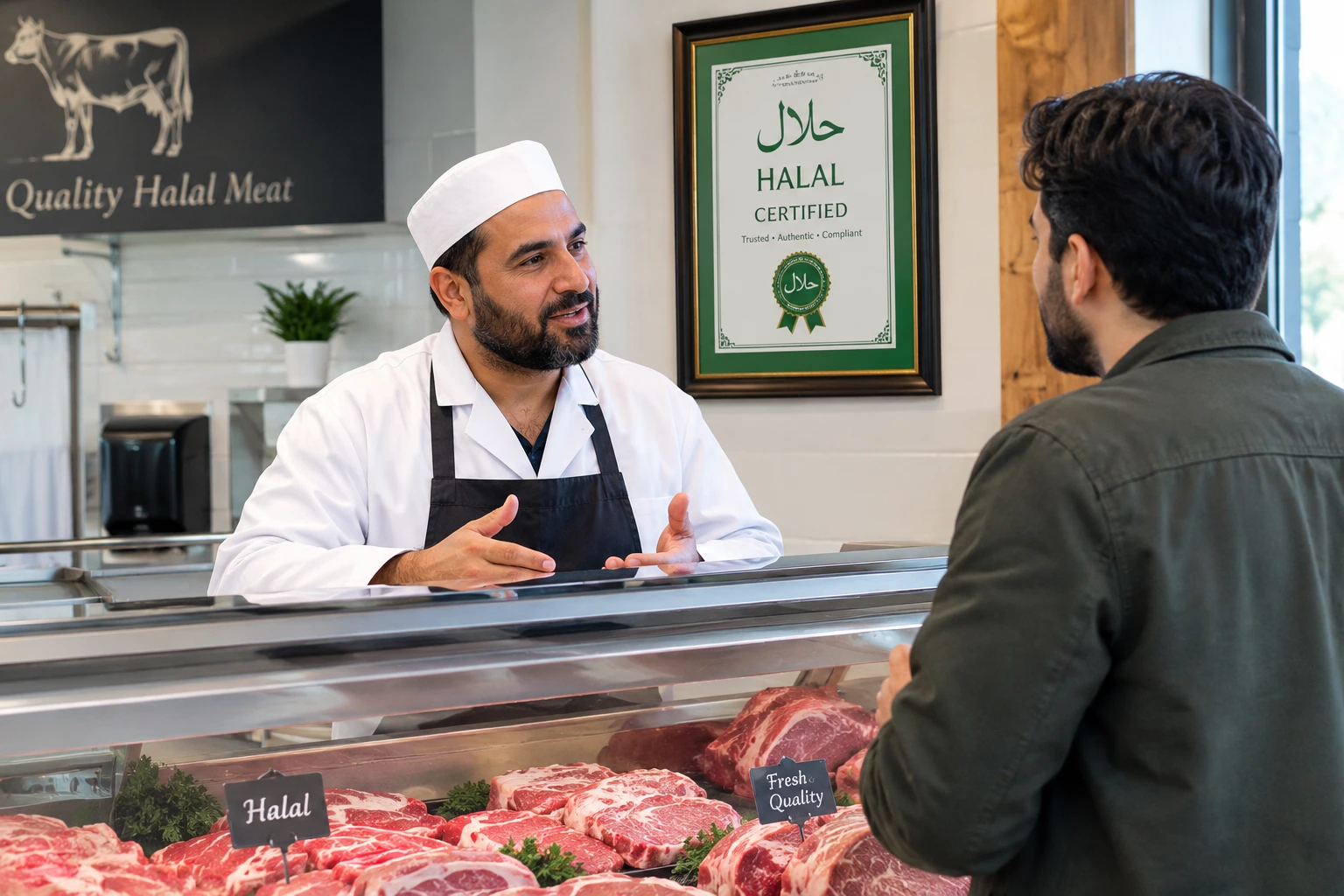
A trustworthy halal butcher can tell you exactly who certifies the meat, where it was slaughtered, and whether it’s zabihah. If they hesitate on any of those, keep shopping.
Ask these questions at the counter:
- Who certifies your meat? A named certifier beats a hand-written “halal” sign.
- Is it hand-slaughtered zabihah? This matters most for chicken, where machine slaughter is common.
- Was the animal stunned? Pick the answer that fits your own practice.
- Do you sell pork or alcohol? Separate knives and storage are a must.
- When did this delivery arrive? Fresh turnover is the real secret to good taste.
The American Halal Foundation points out that processed products like sausages and nuggets need extra care, since casings and flavorings can break halal status even when the meat is fine.
How does Clay Handi source its halal meat?
Every cut of meat we cook at Clay Handi is zabihah halal, and we serve no pork and no alcohol.
We use zabihah goat, lamb, beef, and chicken across our mutton dishes, tandoori grill, and clay-pot handis.
Our halal food page has the details.
Frequently asked questions about halal meat
Can non-Muslims eat halal meat?
Yes. Anyone can eat halal meat, and many non-Muslims do without knowing it, since halal chicken and lamb are widely sold in mainstream stores. There’s no religious requirement for the person eating it. Many non-Muslim guests choose halal restaurants for mixed groups so everyone at the table can order freely.
Is halal the same as kosher?
No, though they overlap. Both forbid pork and require draining blood, and kosher slaughter is also done without stunning. The differences are who performs the slaughter, the blessing said, and further rules like kosher salting and separating meat from dairy. Each certification is separate, so meat must be certified under each system to qualify for both.
Is halal chicken hand slaughtered?
Not always. Some certifiers accept mechanical slaughter of poultry if a Muslim says God’s name while the line runs, while others insist on hand slaughter for every bird. If this matters to you, ask specifically for “hand-slaughtered zabihah chicken” and confirm the certifier, because a general halal label won’t tell you.
Why is halal meat more expensive?
Halal meat often costs a little more because it needs trained slaughterers, separate processing lines, certification audits, and smaller supply chains. Hand slaughter is slower than automated lines. Prices vary by region, and in areas with large Muslim communities, halal meat is often priced close to conventional meat.
Does halal meat have less blood?
Halal slaughter requires that blood be drained as fully as possible, and a beating heart at the time of the cut helps push it out. Conventional slaughter also bleeds animals, so the practical difference in the final cut is small. The religious requirement is the key distinction, not a measurable health benefit.
The bottom line on halal vs non-halal meat
Cheat Sheet
- Halal: permitted animal, zabihah slaughter, blood drained, no contact with pork or alcohol.
- Haram: pork, blood, carrion, and animals dedicated to other than God, never permitted.
- Stunning: accepted by some certifiers if reversible, rejected by others.
- Taste and nutrition: mostly the same; freshness and cooking decide flavor.
- Best move: ask any butcher or restaurant who certifies their meat.
Halal isn’t a flavor. It’s a promise about where your food came from, and like any promise, it’s only as good as who’s making it.
If you’re in Buffalo, Kenmore, or visiting Niagara Falls, come taste zabihah meat cooked in clay pots. You can book a table or ask about halal catering for your next event.
About Clay Handi
Clay Handi is a family-run, zabihah halal Pakistani and Indian restaurant founded in 2011 by Murshad Masud Qazi. We cook handis over open fire and serve them in their clay pots.
Visit us at 3054 Delaware Ave, Buffalo, NY 14217, call (716) 877-7797, or email info@clayhandi.com.